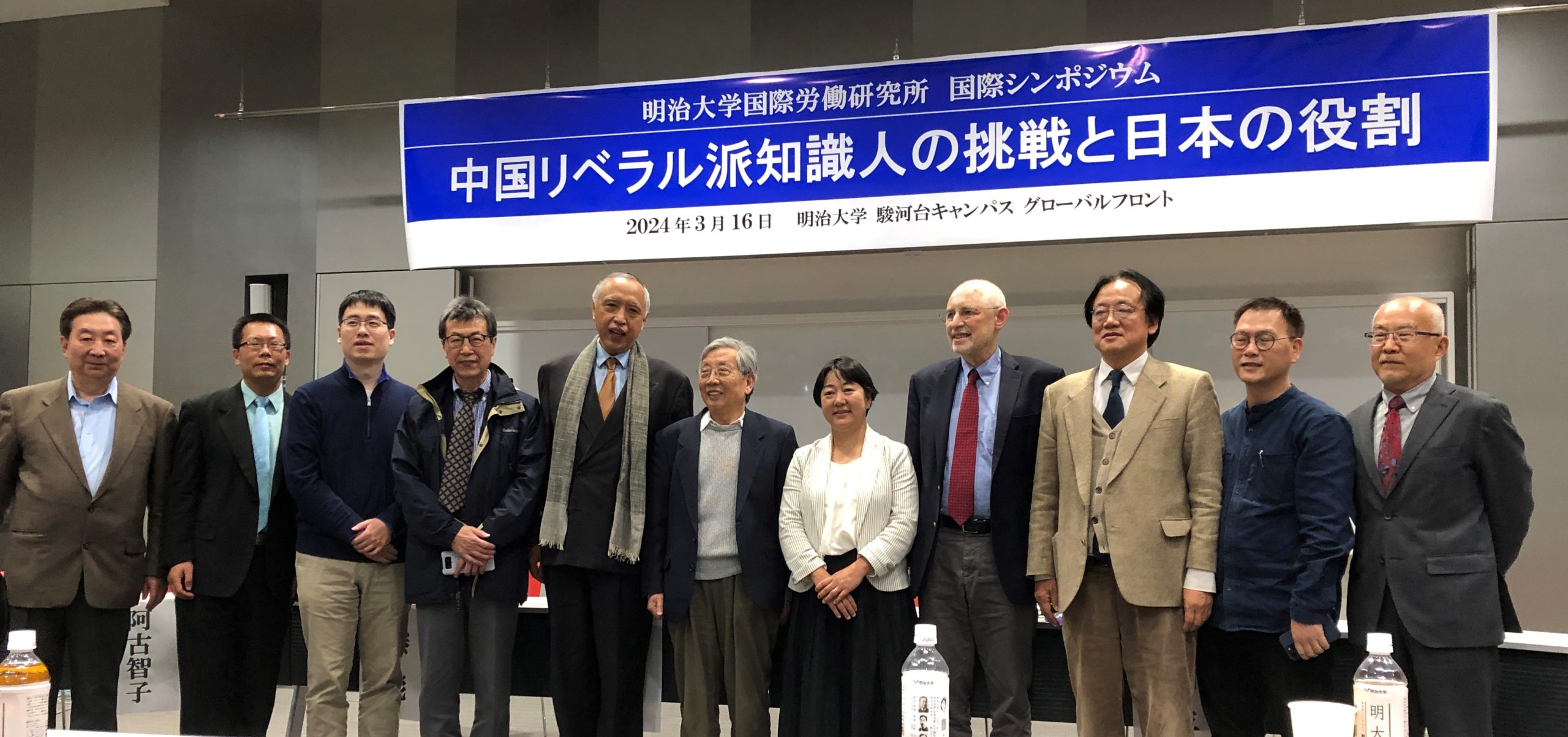
On Saturday, March 16, 2024, an international symposium titled “The Challenge of Chinese Liberal Intellectuals and Japan’s Role” was held at Meiji University in Japan. Speeches were delivered by scholars such as Li Anyou (Professor of Political Science, Columbia University), Hu Ping (former Chairman of the China Federation for Democracy and Democracy, Honorary Editor-in-Chief of ‘Beijing Spring’), Wu Guoguang (Professor at Stanford University), Teng Biao (Adjunct Professor at CUNY and Deputy Editor-in-Chief of China Democracy Quarterly), Zhang Lun (Professor at CY Serge-Paris University), and Zhou Baosong (Associate Professor at The Chinese University of Hong Kong). The seminar was coordinated and moderated by Tomoaki Ishii (Professor, Meiji University School of Commerce), with commentary by Wang Ke (Professor Emeritus, Graduate School of International Cultural Studies, Kobe University) and Tomoko Ako (Professor, Graduate School of Arts and Sciences, University of Tokyo), and Xu Xing (Associate Professor, Graduate School of Law, Hokkaido University) providing interpretation. More than 300 people attended the seminar in person.

The speech summary is as follows:
Li Anyou: China’s “political support”: resilience or fragility?
Most Chinese citizens support the current administration. So-called|” “Support” is a form of “system input” described by American political scientist David Easton, including behaviors such as paying taxes and following rules, as well as attitudes like recognizing the legitimacy of the regime. There are four types of support for the regime. First, fear-based support; Second, performance-based support; Third, support based on shared values; Fourth, support based on identity. Clarifying the types, degrees, and distribution of regime support will help analyze which events will affect the future of the party-state system.
Hu Ping: Massacre and Miracle
Thirty-five years ago, few could have imagined that the CCP’s authoritarian regime could still last until today; Even fewer people would think that in China, lifetime tenure can be revived, and personality cults can be revived.
The most puzzling aspect of studying today’s China is that it is difficult for people to give it an appropriate name or a precise definition. Is today’s China socialist or capitalist? Is it totalitarianism or post-totalitarianism? If you say it is authoritarianism, then is it left-wing authoritarianism or right-wing authoritarianism? We found that no single concept is sufficient to explain the issue.
This shows that to truly interpret today’s China, simply describing the current situation in a static manner is far from sufficient. We must also put effort into dynamically describing history and its origins and developments. Figuring out “how” is important, but it’s even more important to figure out “how.” I will attempt to interpret the history from the death of the great dictator Mao Zedong to Xi Jinping’s establishment of a new dictatorship, and further propose: As Chinese people, how should we promote China’s transition to constitutional democracy, how should the international community engage with China, and help China achieve constitutional democracy?
Wu Guoguang: Breaking the Myth That ‘the Communist Party Will Not Collapse’: On the Transformation from Dissent under Communist Autocracy to the Construction of a Post-Communist Democratic System
TheChinese democratic movement, centered on free intellectuals as its soul, has emerged in the late 1970s and endured nearly half a century of arduous efforts. To this day, it has yet to become a decisive force in China’s political reality, let alone achieve the goals of promoting democratic transformation and establishing a democratic system in China. Among these, there are many subjective and objective reasons, which are not the focus of this report. The main purpose of this report is to focus on the current reality of China under Xi Jinping’s rule, exploring how the freedom movement has transformed from a dissenting and opposing force under Communist rule to a force dedicated to the collapse of the Communist regime and guiding the post-Communist China toward a successful democratic system. Why is this transformation necessary? What does this transformation mean? What is the significance of this transformation for China’s grand democratization transformation? What are the key elements to achieve this transformation? How can the ideas, vision, and plans of free intellectuals be transformed into the actual driving force for China’s great democratic transformation, and in this transformation, the literacy and abilities of free intellectuals themselves can be improved? This report will attempt to answer these questions. Among these, breaking the fundamental myth that China and even the global community always discuss China issues under the assumption that the CCP regime will not collapse is a key issue. The transformation of free intellectuals mentioned above must first confidently break this myth, so as to break free from the series of concepts, logic, agendas, and policies set by the Communist regime to explore and influence China’s future.
Teng Biao: The far-right shift of Chinese politics is due to the split among liberal intellectuals
After the 1980s, as liberal ideas spread in China, liberalism, democratic movements, and rights protection movements emerged as both action and public life, and despite official control and suppression, they still received enthusiastic responses. The rights protection movement in China once showed trends of politicization, organizationalization, street movement, and internationalization, but with Xi Jinping’s rise to power and the establishment of a high-tech totalitarian system, the movement was purged and liberalism fell into a low point.
The CCP regime that belonged to the “far left” during Mao’s era has, since the 1980s, grown stronger with economic and technological development, but has not shifted politically toward liberal democracy but increasingly become an extreme right-wing regime pursuing Han nationalism, nationalism, social Darwinism, and expansionism. On the other hand, liberalism has been misread or ignored in many contexts during its spread in China, with most Chinese liberal intellectuals becoming right-wingers. Against this backdrop, left-wing liberalism has risen in China, facing multiple obstacles from the regime, illiberalism, and the liberal right. The ongoing division and development of liberalism on both left and right wings will have a profound impact on Chinese politics and society.
Zhang Lun: Subjectivity, Power, and Transformation—Also Discussing the Redefinition of China’s Liberal Intellectuals
China’s current transformation is a “dual transformation” in which two intertwined connotations are intertwined within the same process: the “modernization transformation” of Chinese civilization and the “post-communist transformation” of the communist system. The transformation of Chinese civilization that began in modern times went through multiple stages, each with its own unique challenges, but also some fundamental themes that run through the course of history. Every stage has its own accumulation, continuity, and breaks. The construction, transformation, and transformation of the Chinese communist model is also an extremely important stage in this process. The role and fate of Chinese intellectuals, especially liberal intellectuals, bear witness to this project, and their thoughts and actions have shaped it. It was in this process that modern themes with a gradually clearer sense of rights emerged—the individual—but disappeared under the suppression of power in the Mao era. The most important achievement of the reform and opening-up stage was the revival of this theme. However, the distortion of China’s reform model has led to a lack of a return to the main theme and an incompleteness of rights, which are fundamental to the various political, economic, social, and cultural problems currently arising in China. The core of the new social and state power struggle arising from the return of China’s new totalitarianism revolves precisely around the issue of subjects’ rights. Regardless of ideological preferences, China’s liberals need to complete a new clarification, regroup, define themselves with the “rights faction” who fight for and defend citizens’ rights, distinguish themselves from them, and engage in various forms of contest, measure politics, and promote transformation.
Zhou Baosong: Money, Property Rights, and Freedom—A Critique of Laissez-faire
In China, liberalism and right-wing are often seen as synonymous. The right believes that their core value is freedom. To guarantee freedom, we must unconditionally support laissez-faire markets and private property rights, oppose social welfare and wealth redistribution, even if doing so leads to severe economic inequality and social poverty. In right-wing discourse, freedom and market are on one side, equality and justice on the other, and liberalism must choose the former and abandon the latter.
This report will challenge such arguments. This report points out that the nature of private property rights is to protect the freedom of property owners, but also to restrict the freedom of the proletariat. This means that the less property one owns, the less personal freedom they have. If the market leads to poverty, then the freedom of the poor will inevitably be reduced as a result. In other words, the redistribution of wealth does not mean an absolute reduction in freedom itself, but rather a redistribution of freedom among people.
This report concludes: Even if we agree with the right-wing premise, that freedom is a fundamental value, we should not accept its conclusion that the market can maximize and protect everyone’s freedom. On the contrary, a society that values social justice and fair distribution has a better chance of achieving this goal.