Author: Hu Ping, November 2006
Note: On the morning of August 1, 2021, the renowned historian Academician Yu Yingshi (1930-2021) passed away. Academician Yu Yingshi is a globally influential historian. He conducted in-depth research on Chinese thought, politics, and cultural history, connecting ancient and modern times, which is quite rare in today’s academic community. Hu Ping praised: Mr. Yu is a model of humanistic spirit and a loyal friend to exiled intellectuals on the mainland. Special Publication of the Old Article “Congratulations to Professor Yu Ying-shih for Winning the Kruger Prize” to express condolences and remembrance!
Renowned historian Professor Yu Yingshi was awarded the 2006 Kruger Lifetime Achievement Award for Humanities and Social Sciences. Mr. Yu is also an editorial advisor to Beijing Spring. Here, on behalf of our colleagues at Beijing Spring, I extend my warm congratulations to Mr. Yu.
The Kruger Prize is known as the Nobel Prize for the Humanities. Mr. Yu’s receipt of this honor is a full recognition of his academic achievements. Mr. Yu’s remarkable qualities are not only academic, but also personal. Mr. Yu is regarded as a model of humanistic spirit. An old Chinese saying speaks of ‘moral writing.’ In fact, morality and literature are not the same; morality is morality, and writing is literature. There are people in the world who have good morals but poor literature, and those who have poor morals but good writings. But Mr. Yu fully deserves the title of moral essay.
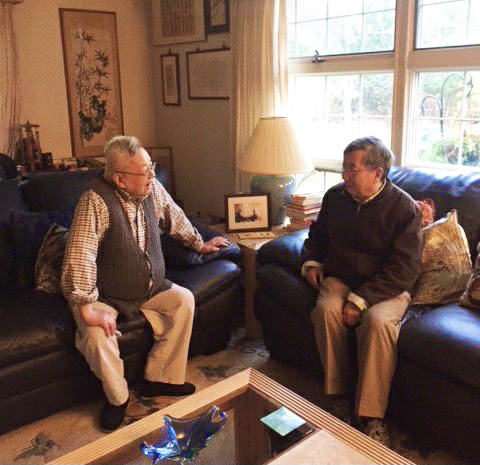
In the 1960s and 1970s, many Western intellectuals, including Chinese intellectuals, were misled by CCP propaganda and rushed to Beijing on pilgrimage. Mr. Yu was not only undeterred by this but also gave serious criticism. The CCP’s June 4th shooting sparked widespread protests in the international academic community, but within a few years, many scholars put those protests behind and turned to the CCP authorities to curry favor. Mr. Yu remained unmoved. This brings to mind Gao Xingjian’s declaration after June Fourth—’In my lifetime, I will never return to a so-called motherland under totalitarian rule.’ I’m not saying that only by not returning to the mainland under communist authoritarianism overseas overseas can we demonstrate their commitment to freedom, but in any case, we cannot help but express respect for the persistence of Yu Yingshih and Gao Xingjian. Since visiting the mainland in 1978, Mr. Yu has not been to the mainland since. As the saying goes, ‘Peach and plum trees are silent, but beneath them a path forms.’ Although Mr. Yu never returned to the mainland, his influence in the intellectual community there grew ever stronger. This is something we are truly happy for Mr. Yu. Mr. Yu was a loyal friend of the mainland’s exiled intellectuals. Mr. Yu has made immense contributions to the establishment and maintenance of the Princeton Chinese Studies Society over many years. Over the years, Mr. Yu has written prefaces for many mainland scholars and writers—both familiar and unfamiliar—which not only shows his care for China and his help to others, but also demonstrates the respect and trust he has in mainland scholars and writers.
Speaking of which, among mainland scholars, I have known Mr. Yu quite early. In 1987, I came to the United States. That October, Zhang Zuojin and Meng Xuan from the World Journal drove me and my Harvard classmate Ding Xueliang to Mr. Yu’s residence in Princeton, arranging a conversation. Since then, we have known Mr. Yu, and counting on our fingers, it has already been nineteen years.
Each field has its own specialty, and Mr. Yu’s professional achievements are not something everyone can fully grasp. However, as a public intellectual—what ancient Chinese called a ‘scholar’—Mr. Yu is a model we can and should emulate.
RFA starters. November 17, 2006