Tian Mu (compiled and edited): August 14, 2023
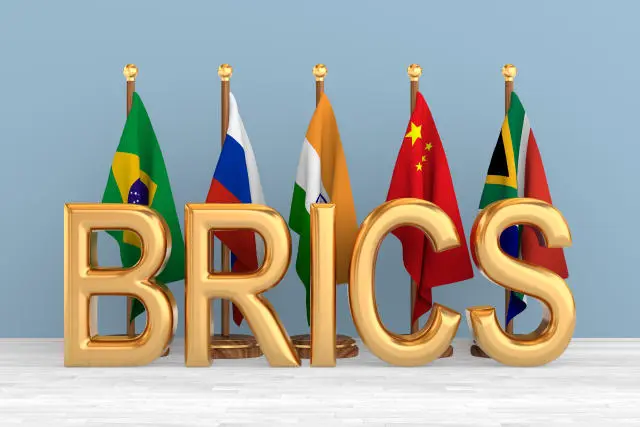
For more than a decade, the BRICS summit has only added a fleeting moment of friendship each year, like a fleeting flower—always just a superficial and flashy event. How could it suddenly become popular now? It seems to have become a major hot topic today, attracting global attention. The reasons are as follows:
1. The turbulence and changes of the political situation. In recent years, the standoff and rivalry between the U.S. and China have been turbulent and intense. At the beginning of last year, when the Russia-Ukraine war began, the US and Europe jointly opposed and resisted Russia, with high sentiment pushing China and Russia into the same camp.
Long-standing discord between China and Russia is not only due to ethnic and cultural differences but also differences in traditional religious beliefs. Coupled with a century of humiliation and territorial concessions, as well as the struggle for the pinnacle of world hegemony, mutual distrust and defenses have become the norm. On the international diplomatic stage over the past decades, China’s relations with the US, Russia, and the EU have been clearly visible: close to the US, pro-EU, and anti-Russian diplomatic approach.
The Russia-Ukraine war has created a “back-to-back” pattern between China and Russia, representing a strategic failure of the U.S.-Europe “geopolitics” and “balance of power.” The United States has formed a camp with NATO, the EU, and the G7; China and Russia have also hurriedly assembled their teams, formalizing and confronting the original friendship boats like the BRICS summit and the Shanghai Cooperation Organization into a confrontational framework, enhancing their confrontation capabilities and combat power.
2. The intense attention and sensational reports from media around the world have also fueled hype and hype. It can be said: when two armies face off, evenly matched opponents, and evenly matched forces is what makes a real show. As the saying goes: ‘Opera performers are not as good as those who watch opera.’
The recent appearanceof the NATO and G7 summits naturally drew media attention. Below: the BRICS summit in Johannesburg. It truly lives up to the phrase from ‘Haoli Ge’: ‘You finish singing, I take the stage.’
The media is actively discussing the main theme of this BRICS summit: first, the expansion camp of the “BRICS Group”; Second, anti-American and anti-hegemonic measures, starting with ‘de-dollarization’; Third, Brazil, Russia, and others have all proposed a “BRICS common currency.”
These points and aspects have become the media’s current focus and interest in the BRICS Summit. “Casual Talk Together” uses the most accessible language to offer readers viewpoints and insights, sharing and exchanging ideas with them.
“BRICS” and “South-South Cooperation
.”Liao Tianqi: The BRICS summit has been held 14 times (once a year), and this 15th summit has suddenly become a global hotspot. This is no coincidence; at least two points deserve global attention:
First, China, Russia, and India have all had glorious times in history, being a country where “better to be the head of a chicken than the tail of a phoenix.” After World War II, Russia was one of the two hegemons of the US and the Soviet Union, the former Union of Soviet Socialist Republics, covering over 22.4 million square kilometers and spanning 11 time zones. It was also the leader of the Warsaw Pact, established to counter NATO. India was an advocate of the Bandung Conference in the 1950s. India’s first Prime Minister, Nehru, was an important leader and organizer of the conference. The Bandung Conference, attended by nearly thirty third world countries from Asia and Africa, adopted the “Final Communiqué of the Asian-African Conference,” which included economic cooperation, cultural cooperation, human rights and self-determination, issues concerning dependent states, and the Declaration on Promoting World Peace and Cooperation. In the 1960s, Mao Zedong proposed the “Three Worlds” strategic idea, collectively referring poor and weak countries to “developing countries” or “Third World.”
Second, the “BRICS Five countries” and “South-South Cooperation” are joining hands. A Chinese proverb says: “Three cobblers are worth more than one Zhuge Liang.” Moreover, among the five BRICS countries, China, Russia, and India exist; they won’t stop until something happens. Joining hands and expanding “South-South Cooperation” is one of the main themes of this year’s conference. “South-South cooperation” refers to the majority of poor and weak countries located in the southern part of the Southern and Northern Hemispheres. Since the 1960s, in order to break free from the control of developed countries and develop the national economy, specialized economic cooperation has been carried out, calling itself ‘South-South Cooperation.’
The problem is that more than half a century has passed, and even though the United Nations led the 2004 proposal to “achieve the Millennium Development Goals through South-South cooperation,” it ultimately became all talk and little action, remaining just slogans and propaganda to this day. Will the partnership between the BRICS five countries and the South-South Organization change the status quo and create a new trend of cooperative development?
For a long time, the world has overlooked the “South-South Organization,” but now the issue has emerged: the “BRICS” and the “South-South Organization” share at least the same goal: to stand on equal footing with developed capitalist countries like the US and Europe, emphasizing the spirit of cooperation and joint efforts among developing countries. With the participation of China, Russia, and India, does it solve the problem of having a leader and a leading country?
The
end of globalization and the “rival competition” pattern
Liao Tianqi: So, does the “BRICS Summit” have the strength to do so? Can it rival the G7’s strength and strength? How will BRICS promote and carry out cooperation with the South-South Organization? What specific steps and policies can be taken first?
Manrunnan: This summit in Johannesburg is the 15th edition, from August 22 to 24, with South Africa as the host country. Just now, Tianqi used the four words: ‘Evenly matched.’ What does it mean to be evenly matched? The “BRICS Summit” used to be ignored and more for self-entertainment. But now it’s truly different—it’s a major event in international politics, closely related to two major concepts
The first is the awareness of globalization. Globalization has sounded the death knell and become the final chapter. Globalization has happened several times throughout human history: Britain’s empire on which the sun never sets, which itself implemented its first globalization. After World War II, the two hegemons of the US and USSR formed, with two camps that lasted until 1990, when Eastern Europe democratized and the former Soviet Union collapsed. The world has returned to a unipolar, American-dominated world. Globalization led by the U.S. began roughly in the early 1990s and has been going on for nearly thirty years now. The convening of this BRICS summit has clearly confirmed that this wave of globalization is dead. What new era will the world enter? This is the era when Tianqi defines it as “rivals,” or rather, it has become a confrontation and competition between two camps.
Second, it opened up a hemisphere economic pattern. I remember we proposed this concept a year and a half ago. The formation of two hemispheres of confrontation: on one side is the Group of Seven representing developed countries, recognizing universal values and democratic constitutionalism, mainly consisting of the US, Japan, Germany, UK, France, Italy, and Canada. On the other side, China and Russia are at the core, along with India, Brazil, and South Africa. Why do I say it’s ‘2+3’? This 2 and 3 are quite different. Of course, there are differences within the G7, such as France, which is out of place with the other six countries, and has even applied to participate in the BRICS summit. However, the seven countries are still centered around the United States, which leads the Anglo-Saxon Four: the UK, Canada, and Australia, which hold the group tightly, while Germany and Italy are on the margins. Relatively speaking, France is more detached, and the degree of closeness is still different. Among the BRICS countries, Russia and China are “back-to-back,” forming a close relationship.
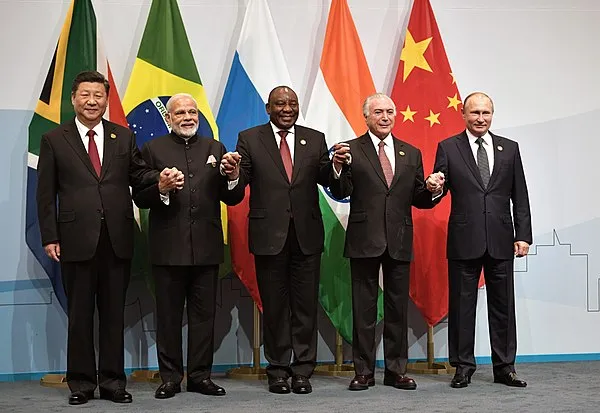 > 2018 BRICS Summit /Wikipedia
Now, globalization has become two hemispheres, with one hemisphere centered on the G7; The other hemisphere is led by the BRICS countries. The G7 is based on shared values, culture, and ideals, with a constitutional democracy and human rights system, and the closeness or cohesion of cooperation is much stronger than that of the BRICS countries.
Institutional differences between the economies of the two hemispheres
Liao Tianqi: I agree. The G7 has a common market economy, which is very important. For BRICS, lacking alliances, cooperation, and a foundation of rules makes such a cooperative combination unreliable.
Wan Runnan: Tianqi’s earlier addition not only reflects ideology but also explains the economic system shared by the seven countries, which lays a lasting and stable foundation for long-term cooperation within the G7. The problem is: Europe opposes the current U.S. subsidy measures; leaders from Germany and France have personally come to the U.S. to demand an explanation. America’s approach certainly aligns with the goal of making America great again, but it does not align with the laws of a market economy. Looking at the current economic situation of the two hemispheres, they are actually learning from each other, but also learning from each other or infiltrating each other.
Among the BRICS countries, the economy is not entirely centralized, with government guidance. Recently, China has turned back again, restoring the private economy, returning to the parallel advancement of state-owned and private enterprises, and continuing to respect and value the path of market economy development. In my view, this is a mixed economic system and does have certain practical effects and significance. Russia has also tightened policies on private enterprises, and India has its own ……. The BRICS countries lack consistency and unity in political systems, ideology, and economic policies. Although the BRICS countries are taking a stance to stand toe-to-toe with the G7, in my view, this is a gathering of a disorderly crowd.
The
historical origins of the G7
Tian Mu: When commenting on the G7, don’t forget history; you must observe and judge from the perspective of historical evolution. Two periods and events are very important.
First, in 1947, after World War II, the United States implemented the ‘Marshall Plan,’ officially named the ‘European Recovery Plan.’ After the war, the United States indeed acted as a generous ally of the Allies and the North Atlantic bloc’s mobile power. The countries benefiting the most from this program (based on aid amounts) were: the United Kingdom, France, West Germany, and Italy, which later became the backbone of the G7 economic group. This was clearly inseparable from America’s generous donations and meticulous aid.
Second, during the first oil crisis in 1973, the United States took the initiative and convened its brotherly countries to discuss countermeasures and methods. U.S. Treasury Secretary George Pratt Shultz invited financial leaders from West Germany, France, and the UK to hold an informal meeting at the White House library to discuss countermeasures. Soon after, Scholz proposed allowing Japan to join, which was unanimously agreed upon by the member states. From then on, the United States, West Germany, France, the United Kingdom, and Japan were collectively known as the Group of Five (G5). In 1975, at the suggestion of the French President and West German Prime Minister, Italian leaders also joined the group, and in 1976, Canada joined. The summit held in San Juan, Puerto Rico, became the first meeting of the G7. Russia was once part of the Group of Eight (G8), but after the Crimea crisis in 2014, Russia was expelled from the Group of Industrials and returned to the G7.
Therefore, the foundation of the G7 group consists of: national political systems, democratic human rights values, a common market economy, over seventy years of interest groups, and more than half a century of group history. In the language of Han Feizi’s ‘Jie Lao’: It can be said that ‘when the foundation is firm, it grows; when the roots are deep, the vision endures.’
The
contingency of the BRICS combination
Tian Mu: The first to propose the concept of ‘BRICS’ was British economist James O’Neil. In 2001, while serving as Chief Economist at Goldman Sachs in the United States, he first introduced the concept because the word BRIC, composed of the initials of these four countries’ English names, refers to Brazil, Russia, India, and China, and its pronunciation is the same as the English word “brick.”
According to statistics from the International Monetary Fund, from 2006 to 2008, the GDP growth rate of the four countries was 10.7%. For several consecutive years, the four countries’ economies have grown rapidly, and their international influence continues to grow. In 2006, the foreign ministers of Brazil, Russia, India, and China held their first meeting during the United Nations General Assembly, marking the beginning of BRICS cooperation.
In June 2009, BRICS leaders met again in Yekaterinburg, Russia, elevating BRICS cooperation to a summit level. In 2011, South Africa officially joined BRICS, expanding the BRICS to five countries, with the English name set as BRICS. Since 2009, BRICS leaders have held a total of 14 summits. India’s behavior is divided and unethical, but we will set aside that for now.
Since 2015, the GDP growth of the BRICS countries has been sluggish, with their prospects continuously shrinking and bleak. Only China and India have maintained relatively stable economic levels, but China’s GDP growth has begun to decline, with the annual growth rate dropping below 7%.
We can summarize it as:
1. The group composition is not a goal-oriented demand of the five governments; it originated from a British economist publishing a research paper titled “Dreaming Together with the BRIC Countries,” which can be described as a wake-up call.
2. In the past decade or so, the BRICS five countries have had no standardized political or economic cooperation plans, nor have they demonstrated any achievements in cooperating governance to the world. Over the past six or seven years, the BRICS countries’ continued contraction and declining growth rates have shown that dreams have fallen through and confidence is lacking, so it can only be a lively formality every year, with networking events outweighing formality or even nothing.
3. In recent years, the US-China standoff has escalated, and with the ongoing Russia-Ukraine war, China and Russia have politicized the BRICS summit, gathered and expanded anti-US camps, and started with ‘de-dollarization’ local currency settlements, launching a full-scale rivalry in the hemisphere’s economy.
Comparing the BRICS five countries and the Group of Seven, Lao Wan used the term ‘gathering of a disorderly crowd’ for the former. In my opinion, judging from the process, form, content, and purpose of the BRICS group, the wording is very appropriate and fitting.
Monitor the strength of both groups through data
Liao Tianqi: Comparing the strength of the G7 and BRICS, in 2022, the G7 member countries accounted for less than 10% of the world’s population, but the combined GDP of the G7 reached 42.46 trillion USD, accounting for 42% of global GDP, almost half the total. Moreover, most G7 industries are in the mid-to-high-end segment, accounting for over 43.1% of the global mid-to-high-end sector, so their role in guiding and playing a role in the world economy is crucial.
TheBRICS five represent emerging market nations, with a land area accounting for 26% of the world’s total land area and a population of 42% of the world’s population. According to International Monetary Fund statistics, from 2006 to 2008, the GDP growth rate of the four countries was 10.7%, attracting global attention. But in 2022, the combined GDP of the BRICS countries was only $23.52 trillion, accounting for 23% of global GDP—less than a quarter.
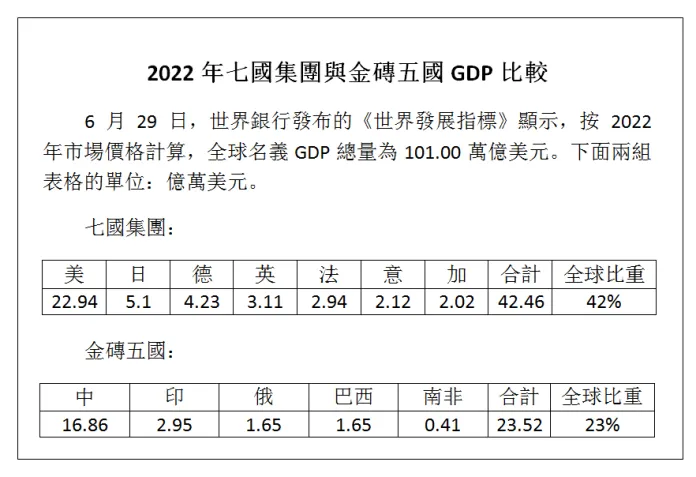
Judging from the population and GDP output of the two opposing groups, it is clear that the G7’s strength should not be underestimated and remains more than sufficient. The BRICS countries are self-aware, and they have taken the position of developing country by joining hands with the South-South Cooperation Organization, which is beyond words.
“Chinese-style” state intervention
Liao Tianqi: The BRICS five also have some governance features that the G7 lacks. The so-called “Chinese characteristics” have always been promoted as a major advantage.
Wan Runnan: Yes, to put it bluntly, it’s ‘Chinese-style’ state intervention, focusing resources on major matters. Its efficiency is definitely faster and more efficient than those market-regulated actions.
The key factor in market regulation is certainly correct. The entire economy that has developed to this day and created the world’s prosperity today mainly relies on the market economy. The most important thing in a market economy is to respect everyone’s creativity, which is why it presents endless new inventions, breakthroughs, and new creations, bringing continuous surprises and joy to the world. Everything in people’s lives today—washing machines, refrigerators, color TVs, computers, from the internet world to artificial intelligence, and so on—has all emerged and emerged from the Western market economy.
State intervention has an advantage: the invention and breakthrough of the market economy from zero to one is extremely difficult and difficult, but in the process of turning one into multiple, state intervention plays a role, following the Chinese approach of “short, smooth, and fast.”
Population and land resources in a major power economy
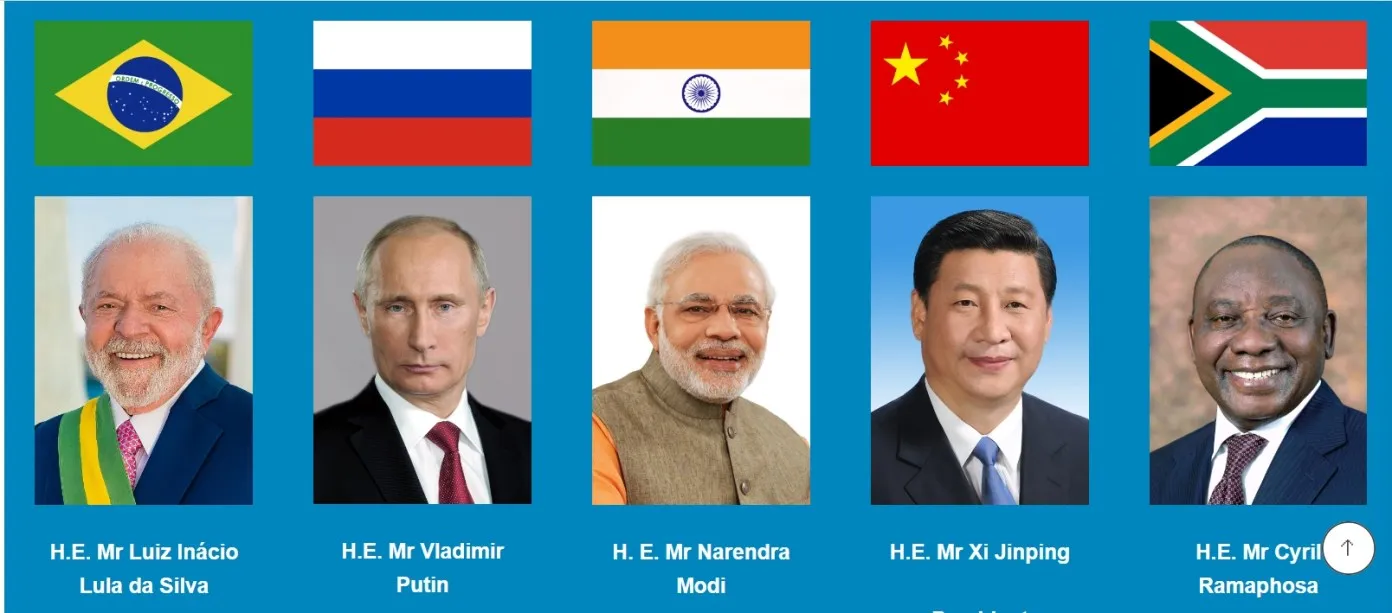
Liao Tianqi: The BRICS five countries are all extremely populous nations. China and India are both resource-rich countries and natural resources, so they can be considered resource-rich countries. Brazil, South Africa, and Russia are also resource-rich countries. Geopolitically, they are located on four continents. What Lao Wan just said is very important: China and Russia define the “2+3” system very well. Brazil, India, and South Africa are also somewhat democratic countries. Therefore, politically, this bloc is a mixed system, and economically, it is not dominated by the ruling party but is also a market economy.

One more thing: a country, or a large economic and political entity, depends on three very important elements: labor, land, and resources. BRICS accounts for 42% of the world’s population, nearly 25% of the land, and the third factor is resources. Perhaps the BRICS five countries are not yet capital-rich, but China has developed rapidly in recent years, and India is also developing rapidly, showing promising momentum.
Wan Runnan: Nowadays, the G7 and BRICS countries are evenly matched in terms of population, land, and resources, and have now entered a stage of deep competition. Among Western countries, the United States is the dominant and leading power. In terms of manufacturing, Germany and Japan are the main competitors, with Canada and Italy showing a slight gap. The UK, on the other hand, is currently facing economic problems. After leaving the EU, its former empire has become a solitary flock.
Each has its strengths and weaknesses
Wan Runnan: I read an analytical article that discusses which of these major European countries is currently developing the best.
Tian Mu: France. According to preliminary data released by Eurostat on July 31, France’s GDP in the Eurozone grew 0.3% quarter-on-quarter in the second quarter of this year, while the EU’s GDP grew by zero quarter-on-quarter. At first glance, these data may not stand out, but when compared among the EU’s economic powerhouses in Q2, Germany, the EU’s largest economy, saw zero quarter-on-quarter GDP growth, while Sweden, Latvia, Austria, and Italy also saw their GDP contract.
Wan Runnan: Don’t be fooled by France’s constant street fighting, smashing, and robbery; looking at the bigger picture, all its economic indicators are the best. In fact, France was hit hardest by the Russia-Ukraine war, as its Manager-Buyer Index has dropped to the 30% range. Generally, a rate below 50% is considered an economic downturn. China’s index has now dropped to 48% or 49%. Of course, whether this figure is reliable is another matter, but in the context of global economic cooperation, the generation and evaluation of such data are difficult to falsify.
So from the perspective of the global economic outlook, the situation is still quite grim. Many countries have performed poorly on this data, with their figures dropping to around forty percent, and Germany even dropping below forty percent. In summary, each has its own advantages and problems. A classic line from Dream of the Red Chamber also sharply criticizes the current global economy: “Big has its difficulties, small has its benefits.”
The U.S. is also full of problems, with domestic political divisions and unlimited debt expansion—these are all heavily threatened. People usually say there are three major bubbles in the modern world: first, the U.S. stock market bubble; second, Japan’s debt bubble; Third, China’s housing bubble. It now seems that at least two major bubbles are on the G7 side. Once China’s housing bubble bursts, it will repeat the fate of Japan’s 1990 economic downturn and enter the Great Depression. The problem is that China used authoritarian power to avoid bursting the bubble.
This world is not an era of competing in goodness, but one of competing in worst. The BRICS issues are also quite complex. China has its own differences, BRICS has its own differences, and the G7 has its own differences. Their problems are different.
Wise and keen politicians have actually recognized the current problems: the crises facing countries and regions today are not the other’s problem, but their own. I think America has two young politicians with clear minds and keen observations: Rubio and Sullivan, both born in the 1970s. Lue was born in 1972, and Shah was born in 1976. I noticed a very important point about them: First, the West has not been able to change China; it is China that has changed the West; Second, our problem today is not China’s problem, but our own problem. This is very insightful and to the point. The same goes for China, saying that the US is suppressing China, but what can the US do to China? Actually, it’s not just a problem with China’s own political and economic system!
China has a problem with its central leadership
Wan Runnan: China’s political reform has been talked about for half a century. No matter what Deng Xiaoping said, he took a big step forward. No matter how you look at it, later Jiang Zemin and Hu Jintao could be considered “Deng Gui, Jiang Hu Sui,” but under Xi Jinping, the path of reform came to an abrupt halt. Xi Jinping is a man who is bad, stubborn, and foolish, leading China into its current state. To be honest, China is currently relying on its past gains, benefiting from 40 years of reform and opening up. Many ordinary people are actually living off their reserves because they have some savings after getting rich recently. After three years of zero-COVID policy by Xi Jinping, and now it’s all reckless, for the sake of Xiong’an and his face, the people can be treated as if they were human.
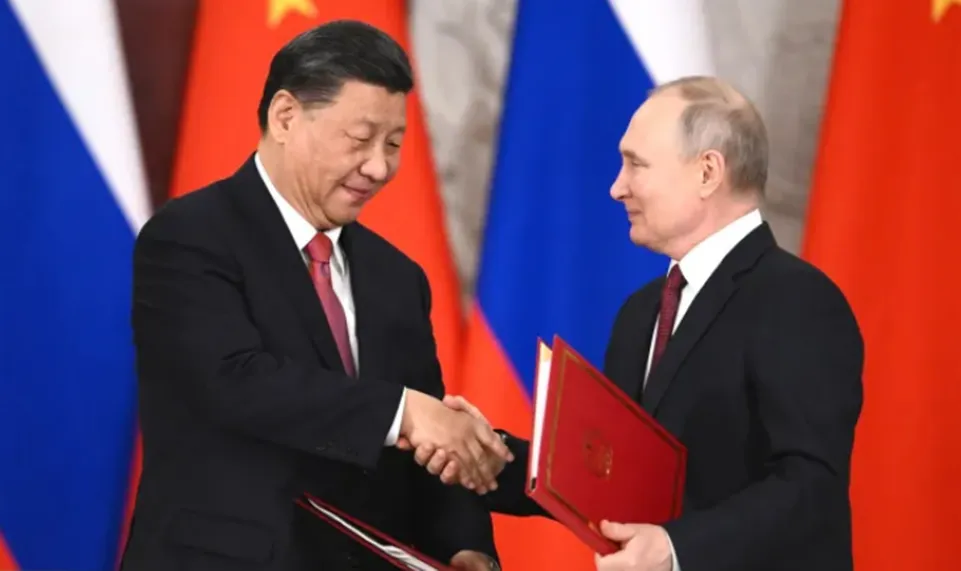
In short, China’s problems are a mess of messes! But even so, no matter how bad China is, it cannot solve America’s problems; conversely, no matter how many problems America has, it cannot solve China’s problems. Each of the five BRICS countries has its own problems, which should be resolved by each nation.
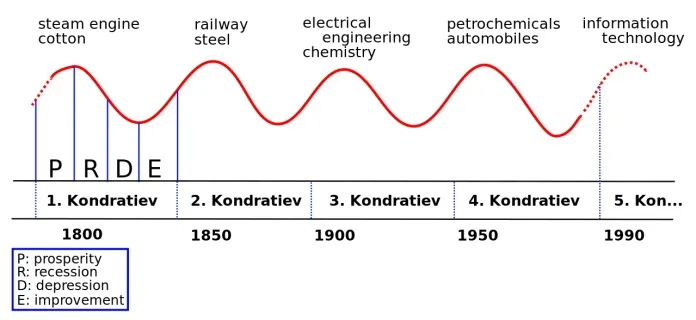
Similarly, if both the G7 and BRICS countries adopt this attitude, why do I say attitude matters? This relates to the consequences of hemisphericization, and at worst, war between the two camps. Now, in fact, another Kondratiev cycle has begun. The 1920s coincided with the Great Depression in the United States. How to solve the problem? The two world wars resolved the issue, and now it’s the 1920s, facing a new Kondratiev cycle. Moreover, the Russia-Ukraine war is already ongoing, with tensions on the Korean Peninsula, Taiwan Strait, and the Middle East. So after this hemisphericization, the worst-case scenario is to resolve issues through war.
Humanity is now facing the danger of world war
Tian Mu: Observing the present from the perspective of world war history:
1. Two major camps divided by national interests. During World War I, the “Germany, Austria, and Italy Allies” and the “British, French, and Russian Entente” emerged; During World War II, the “Axis Powers of Germany, Italy, and Japan” emerged, along with the “Allied Powers of the United States, Soviet Union, Britain, China, France, and others” (eventually expanding to 57 countries). Since the Russia-Ukraine war, the global landscape has gradually converged from the “tripartite and four-sided” pattern of the US, China, Russia, and the EU into a clear international bilateral bloc standoff and contest. On one side is NATO and G7 power led by the US and Europe; on the other is the “BRICS” led by China and Russia, the “SCO Group,” and South-South cooperation forming a bloc of confrontation and counterbalance.
2. War mode is escalating. World War I mainly involved trench warfare with machine guns, grenades, and artillery; World War II was a war of sea, air, oceans, and continents; This third world war is no longer a conventional war pattern; it should be that the US and China have launched diplomatic, economic, technological, and military wars in all aspects, while the BRICS summit, the SCO summit, NATO summit, and the G7 summit should be seen as diplomatic battles between the US and China.
3. The worst-case scenario of entering the new Kondratiev cycle, where the hemisphere economy and blocs are divided and competing, is a world war to solve the problem. The recent peak of the G7 summit has become a backdrop and reference point for the BRICS summit. The world has entered a state of “unrestricted warfare,” meaning battles, modes, and wars that go beyond “boundaries.”
I also believe that war is inevitable; human history is accompanied by war, and it is an inevitable process of social development and progress. Imagine if human history had not experienced war, humans might still be stuck in primitive cave societies. Of course, war also threatens human survival, but the threat is temporary; development is eternal. War is like the steps of human development; human society moves forward step by step on the steps of war. Looking back at the journeys of World War I and World War II, each war represents a comprehensive leap in society, economy, and technology. However, how much positive significance war has for human survival and development is debatable.
The U.S. offers an opportunity for “de-dollarization.”
Tian Mu: Old Wan talked about the political background of the BRICS countries, which is actually distant. For example, India doesn’t want to attend the South Africa meeting this time because the US has provided India with many benefits, and the EU is actively trying to win India in. Faced with the powerful economic backing of industrial countries from the US and Europe, India finds it hard to choose. Which should be prioritized, of course, comes first—this is an ironclad truth. China and India themselves have old and new grudges, making it difficult to get along and reconcile. Back when India joined BRICS and leveraged Russia-China power, it was also reluctant to join the group under the circumstances of ignoring the US and the EU.
Liao Tianqi: I have two questions: First, since BRICS has many issues, India and Brazil oppose expansion, but both soon changed. Prime Minister Modi still decided to personally attend the meeting in Johannesburg. Both Brazil and India have stated they do not oppose expansion, and changed their stance: if these countries can comply with the rules set at the summit, we welcome them to join.
Second, the number ofcountries applying to join BRICS is steadily increasing. Currently, 13 countries have formally applied, and according to the latest data, 40 countries hope to join. Given so many issues with BRICS, why do they apply to join? Are these countries acting blindly?
 The
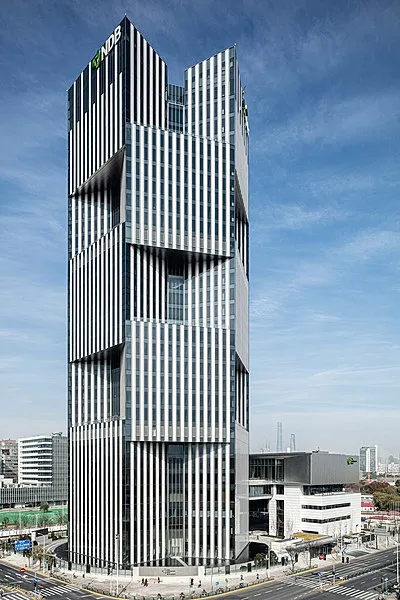
Wan Runnan: That’s a good question. It should be said that the BRICS five countries are just the name of a group, but they are very important to China: first, it helps with de-dollarization. The more countries that join the BRICS group, the more de-dollarization becomes a solo effort, but rather a continuous formation of blocks that ride the momentum. This year, the BRICS Bank headquartered in Shanghai was established, and at least the unification of the global financial system between the US and Europe was changed by the birth of the BRICS Bank.
A second-hemisphere economy must have an independent financial system and currency. Whether it’s the World Bank or the International Monetary Fund, there is a serious problem: the settlement currency is the US dollar, and the final decision-making power in international finance lies with the United States. The U.S. debt crisis, the annual economic inefficiency, reliance on large amounts of printed dollars and increased Treasury issuance are ultimately gradually absorbed and borne by dollar-using countries. The euro was established to avoid the dollar’s harvesting and erosion as much as possible.
Third, de-dollarization must proceed gradually. China has not made a grand declaration to de-dollarize the dollar; the best way to de-dollarize international trade is to settle in its own currency. Local currency settlement is a transitional period because China’s current global economic and trade share is very small. The Chinese government has not proposed settlement in RMB but in local currency. As the saying goes: two people travel together, three people form a row, and many people form a powerful force. Therefore, the more member countries participate, the faster and more robust the pace of de-dollarization can be.
Finally, there is an overview, and Rubio and Sullivan’s conclusion: China’s ability to obtain this opportunity is advocated by the United States.
For example, Iran is sanctioned by the U.S., not allowed to use the US dollar, and its trade with China can only be settled in RMB. There are still many countries in the world that have borrowed money from the World Bank and the International Monetary Fund. Now, the US dollar keeps raising interest rates, aggressively raising rates, which has only increased their debt burdens. China stepped forward, stating: Bank of China lends you US dollars to repay debts, and in the future, you can repay them in RMB, creating a ‘debt swap.’ As a result, the debt previously owed to the US dollar becomes debt owed to the renminbi, increasing the international circulation of the yuan and increasing demand, so this opportunity is also provided by the United States.
Another theory behind this US rate hike is that it’s to shrink liquidity and bring dollars back. Once the US borrows back, countries borrowing US debt will have high interest rates that can’t afford it, and if they can’t repay, their economies will go bankrupt. In the end, they’ll have to use quality assets (like energy, mining, and other good things) as capital collateral for the US. Wouldn’t the US have easy access to it? The US is seasoned and knowledgeable about finance.
BRICS Common Currency Outlook
Liao Tianqi: In April this year, Russian State Duma Deputy Chairman Babakov declared that BRICS was discussing the creation of some kind of BRICS currency, possibly a digital currency, scheduled to be discussed at the BRICS summit in August. Brazilian President Lula has also actively advocated for the establishment of a common BRICS currency. BRICS is creating a new payment medium based on the strategy of “not defending the dollar or euro.” There are also reports that this new currency will be backed by gold and other bulk commodities such as rare earth elements.
Wan Runnan: Brazil is leading the way in de-dollarization. Back then, Brazil was exploited by the US by collateralizing assets, and Brazil is deeply pained by this.
Brazil was once a developed country and has now crossed the threshold of developed nations. It can manufacture its own aircraft, has a strong manufacturing industry, abundant natural resources, and mineral reserves among the world’s top levels. It is self-sufficient in food and clothing, and its people have enough to eat. Back then, during a wave of American exploitation, many Brazilian farms became American capital.
In the 1970s, attracted by low-interest U.S. funds, Latin American countries like Brazil and Argentina borrowed to develop their economies, driving the economic boom of Latin America during the 1970s. Statistics show that in 1970, Latin America’s total external debt was only $21.2 billion, but by 1982 it had risen to $328.7 billion, a 15.5-fold increase, with Latin American debt soaring sharply. As the Fed tightened monetary policy, the US dollar index rebounded, and large amounts of international capital flowed out of Latin America, returning to the US through investments in US futures, Treasuries, and securities. This triggered a bull market in the three major US markets. Countries dependent on borrowing were unable to repay debts, a debt crisis erupted, and asset prices plummeted. Subsequently, US capital launched a counterattack, severely cutting the wool of the Latin American economy, with Brazil being one of them.
This time, Lula is in tearsin China, recounting the bitter consequences of “cutting leeks” in Brazil through debt borrowing—a bitter fate Latin American countries have endured for decades. Therefore, Lula advocates de-dollarization and settlement in renminbi. The BRICS Bank is headquartered in Shanghai, and its first chairman of the board was former Brazilian President Dilma Rousseff.
Liao Tianqi: In 2014, BRICS Group created a $100 billion development bank and over $100 billion worth of reserve currency. The New Development Bank (NDB), commonly known as the BRICS Bank, established a smaller joint reserve lending system, which is publicly referred to as the “Mini International Monetary Fund (IMF).”
Wan Runnan: This is a big deal. It means that America’s global financial hegemony, or rather, the unification of the financial world, has been split in two.
Tian Mu: I don’t think it will go that smoothly, nor will it be so fast. The BRICS group has many weaknesses, such as differences in political systems and economic systems among countries. If major changes occur in international politics, will BRICS’ cohesion be compromised? All of these factors will affect BRICS Group’s economic cooperation and development.
Wan Runnan: Of course, there are many issues with the RMB, but the solution can only be gradually overcome and corrected as we move forward. The key is to persist in the direction without changing the direction. Looking at the G7 and the US-led US-Europe camp, there are also many problems: who buys US bonds? When will the continuous rate hikes ever end? The U.S. is also sitting at the center of the storm, bearing significant risks. As always, everyone has their own problems.
To solve the current problem, the bigger idea is to de-dollarize the BRICS countries. China’s current problem is overcapacity, especially in infrastructure materials like cement and rebar. If the market shrinks, what will happen to this capacity? The “Belt and Road” initiative provides channels and sales channels for China to ease overcapacity, transferring backlogged infrastructure materials, surplus infrastructure, and even wealthy labor out of China. For example: Malaysia is restarting the 180 billion Singapore High-Speed Railway (also known as the Singapore-Malaysia High-Speed Railway), which is 350 kilometers long and has 8 stations, reportedly the largest infrastructure project in Southeast Asian history. Another example is Vietnam’s high-speed rail, which starts in Hanoi and ends in Ho Chi Minh City, with a total length of 1,570 kilometers. It was originally built by a Japanese company, but Japan has abandoned it for certain reasons and hopes China will step in. China has strong infrastructure capabilities, enabling Southeast Asian countries to undertake the establishment of China’s production chains, low-end production chains, high-speed rail, power facilities, and more. By releasing this surplus capacity, China will actually gain access to a broader global market. What does China need? It’s simple: grain, minerals, resources, and so on.
Conclusion: Change is eternal
Our cautionary reminder:
1. Before and after President Biden’s election, we predicted that he would not continue Trump’s policies, insist on America’s great solo struggle again, and instead unite with the democratic bloc to form a final showdown against the CCP’s authoritarian dictatorship. Later, we also saw alliances formed but thrown into the Russia-Ukraine war, paying the price of global strategic losses and costs in order to achieve local balanced strategies and interests.
2. If Trump wins the next election, he will make his promise to ‘end the Russia-Ukraine war immediately,’ and his victory proves the sentiment and sentiment of American public opinion. What would that scene look like? International politics will once again become turbulent. The significant costs and costs EU countries have paid in recent years—social stability, economic downturn, energy chain disruptions, financial donations, weapons support, international diplomacy, time, and effort—will all be more costly than gained—won’t they repeat the mistakes of Afghanistan? As Mencius said, ‘There were no righteous wars in the Spring and Autumn period.’
3. The world knows that Trump and Putin admire each other and are closely connected. Will the U.S. abandon its U.S.-Russia hatred? Just like Nixon of the Republican Party back then, suddenly changing his anti-Communist stance and passionately embracing Red China and Mao Mao. Moreover, Trump no longer has worries about running for the next term. Will he stand firm and stick to his views? If so, will the world fall into chaos? How will Europe-Russia relations change? For BRICS, this could also lead to the awkward situation of cutting off the root cause, potentially losing a common anti-American pillar. How should China-Russia relations be handled? What will BRICS rely on to fully cooperate and jointly promote this grand event?
[Casual Talk on the Walk of Three People]: Confucius said, “When three walk together, there must be one who can be my teacher; Choose what is good and follow it; correct what is not good.” The Master further said: ‘When you see the virtuous, aspire to be like them; when you see the unworthy, reflect inwardly.’ Even if it’s just gossip and rambling about what the world is satisfied with, I dare not rashly claim it as a wake-up call. Whether you listen or not is ……up to you
Wan Runnan: Chinese computer software engineer, entrepreneur, and dissident. He founded Sitong Company in 1984, went into exile overseas in 1989 due to the June Fourth Incident, where he founded the Democratic China Front and served as Secretary-General and Chairman.
Liao Tianqi: Vice Chairman of the International PEN Peace Committee, President of Voice of Europe.
Tian Mu (Pan Yongzhong): Editor-in-Chief of Voice of Europe, Secretary-General of the Democratic China Front Headquarters.
Reposted from Voice of Europe